
POP displays 101
Point-of-purchase displays put your product in the spotlight for in-store interaction. What they are, how they differ from point-of-sale displays, the formats to choose from, and how to decide what yours should be and where it should stand.
- First published
- February 8, 2022
- Formats covered
- Ten: gondola, dump bin, freestanding, display case, endcap, counter, club pack, corrugated pallet, pallet skirt, shelf talker
- Decisions
- Intent, audience, location
The basics
What are POP displays?
Point-of-purchase (POP) displays function as a separate space for shoppers to interact with your product, beyond the standard aisle shelf. Instead of waiting for the shopper to stumble upon your product on the shelf, POP displays are set up in the open spaces of the store, called “action alleys.”
POP displays are meant to target a shopper’s in-store interaction with your product and put it in the spotlight, as a way to direct attention to a specific brand or special offer.
Two kinds of display
POP vs POS
POP displays and point-of-sale (POS) displays play the same role in bringing more attention to your product, but they differ in the types of products that are most effective for each. As their names suggest, POP displays can be found in any open space where a shopper will be making purchasing decisions, while POS displays are relegated to the areas where shoppers pay for products, such as a cash register.
POP displays are better suited to larger products that take up more space and may be more of a commitment for the customer to purchase. POS displays are typically used to showcase smaller products, like candy or snacks, that shoppers will be compelled to buy on impulse.
Side by side
| Difference | Point of purchase (POP) | Point of sale (POS) |
|---|---|---|
| Where it stands | Any open space where shoppers make purchasing decisions | Where shoppers pay, such as the cash register |
| Products it suits | Larger products that take up more space | Smaller products, like candy or snacks |
| The purchase | More of a commitment for the customer | An impulse buy |
Formats
Types of POP displays
The benefit of POP displays is the versatility in design and style they offer. A display is an opportunity to showcase your brand or the imagery for a special promotion, and generally to let your creativity run wild to attract shoppers’ attention. Before you can begin designing your display, though, you need to know what kinds of displays you can choose from.
Gondola display
Gondola displays are standalone shelving units placed past the aisles, in the more open spaces of the store. They typically have adjustable shelves that can be set for different-sized products. Despite being made up of only a steel frame and a pegboard, gondolas give you the opportunity to advertise your brand more directly through the packaging style and logo.
Dump bins
Dump bins are perfect if you’re advertising a product sold individually packed. True to their name, they are large bins filled with an individually packed product, built to push impulse buys by letting the shopper reach in and pull a few products out. They are easy for a field team or distributor to ship and set up, and offer more creativity in how you incorporate your brand’s image.
Freestanding display
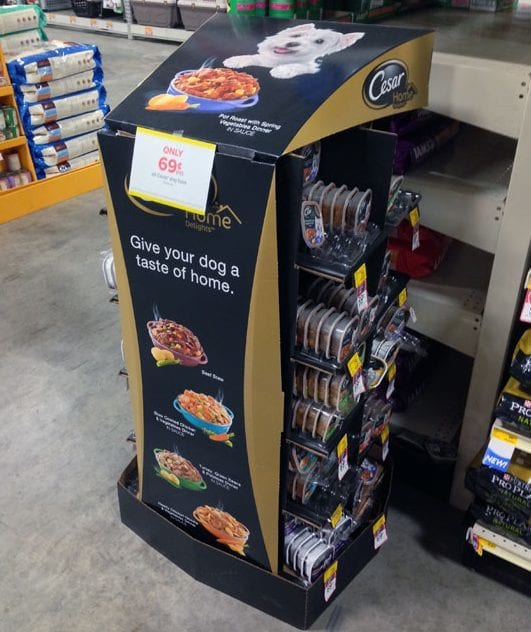
Freestanding displays work like dump bins as a standalone display that can be approached from any direction. Where they differ is in their ability to neatly showcase larger items stacked on top of each other, on shelves, or on hooks. They are made of the same cardboard material as dump bins, so they are just as good for exploring creative branding and design.
Display cases
Display cases are standalone shelving units encased in glass or clear plastic. They are best for combining ornamentation with security, since customers may have to ask an employee to remove an item for them. Occasionally a display case is only for show and shoppers retrieve the item from its home shelf, but more often display cases house higher-end products for security.
Endcap displays
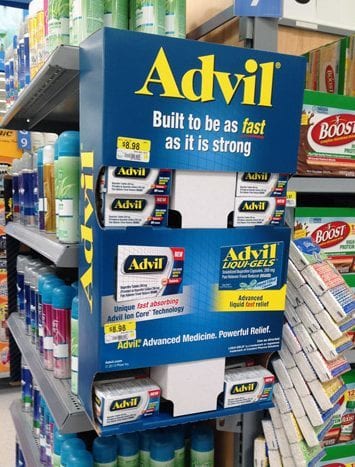
Endcap displays, as the name suggests, are set up at the end of an aisle along the flat siding of a shelf. Endcaps don’t require the open space that most POP displays need. Instead, they are tucked neatly to the side of the main walkways, which puts them in the prime spot to grab customers’ attention without the shopper having to go down an aisle.
In the aisle
Every format at a glance
The five formats above, together with the counter, club and pallet formats described on our point-of-purchase displays page.
| Format | Where it stands | Best for |
|---|---|---|
| Gondola | Past the aisles, in open floor space | Products of different sizes on adjustable shelves |
| Dump bin | Open floor, reachable from any side | Individually packed products bought on impulse |
| Freestanding display | Open floor, wide aisles, or beside a complementary item | Larger items stacked, on shelves or on hooks |
| Display case | Store floor, behind glass or clear plastic | Higher-end products that need security |
| Endcap | The end of an aisle | Shoppers who never walk down your aisle |
| Counter display | Any store counter, often by the register | Small products and impulse buys |
| Club pack | Club stores | Large-volume products; must meet club-store requirements |
| Corrugated pallet display | Open floor | Storing and selling large volumes, without club-store requirements |
| Pallet skirt | Wrapped around a pallet | Large volume, simpler and lower than a full pallet display |
| Shelf talker | On the aisle shelf | An inexpensive way to stand out within the aisle |
Why use them
Why use POP displays?
Seen first, chosen first
In the store, it’s important to capture the shopper’s attention before they move on to another product. In-store POP displays isolate your product from its competitors and display your brand more prominently. By making sure the shopper sees your product first, you limit the shopper’s perceived options and increase the chance that they choose your product over another brand.
A stronger brand impression
By saturating your display with your brand’s imagery, you leave a stronger impression on the customer than if they had only seen your product on the shelf. The more recognizable your product is, the more likely shoppers are to pick it up rather than an unknown brand.
The purchase they didn’t plan
POP displays also make your product the purchase a shopper didn’t know they needed until they saw your display, also known as an impulse buy. Moving your products to the foreground of a store’s space keeps them in a shopper’s mind just long enough to be picked up, even if they’re not on the list of planned purchases.
Implementing POP displays: intent, audience, location
Now that you know what display options are available, you need to determine the intentions, audience and location for your POP display.
Intent
Intent is what exactly you are trying to advertise with the display. Are you announcing a limited-time deal on your products, or getting the word out about a new type of product you’ve just released? If you need more text to get your message across, you’ll need more surface area to carry it. These motivations help narrow down which display best fits the goal.
Audience
Deciding who your audience is also means deciding what kind of retailer will exhibit your display, where in the store it will be placed, and who your target demographic is. The audience for a grocery store is different from that of a convenience store or a retail store, and each audience’s motivations differ: a shopper in a convenience store typically has a better idea of what they’re looking for than a shopper in a grocery store.
Location
Going back to whether your display will be in a grocery store or a convenience store, where it is placed within the store can determine how much attention it receives. In a convenience store, where shoppers head straight to the product they need, set your display up at the front so shoppers see it as they walk through the door. Grocery stores have more space and more leisurely customers, so you can place your display further into the store, where shoppers will see it as they wander the aisles.
Trust in MGA’s innovations
Build your display with MGA.
MGA Innovation designs, creates and delivers POP displays that bring your creative vision to life without burning through your budget. Our co-packing specialists can help you develop a step-by-step plan to build your POP display and guide you to the option that best suits your goals.
Because the display is built and filled in the same plant that packs the product, the display and its contents ship together, shelf-ready. See how we build and pack out displays, or the To the Shelf programs they belong to.
Keep reading
Related pages
- Point-of-purchase displays
The service: counter, club and pallet displays designed, built, filled and shipped.
- Endcaps and club resets
Display programs as part of a retail launch.
- Hand assembly
For oversized and unconventional display pieces.
- Custom package design tips
Where you sell, who buys, and what your brand requires.
- 6 reasons to partner with a 3PL company
- Top 4 benefits of working with a co-packing company
- What we need to quote
The intake checklist for a display quote: what to send with the brief.
Ready to shop POP displays?
Contact us to start designing your display and put your ideas into motion.